If you have ever heard a breathy, wooden flute in a piece of Arabic, Turkish or Persian music, there is a good chance you were listening to a ney (also spelled nay). It is one of the simplest-looking instruments in the Middle Eastern orchestra: a hollow tube of cane with a few holes. It is also one of the oldest, and it asks more of the player than it first appears.
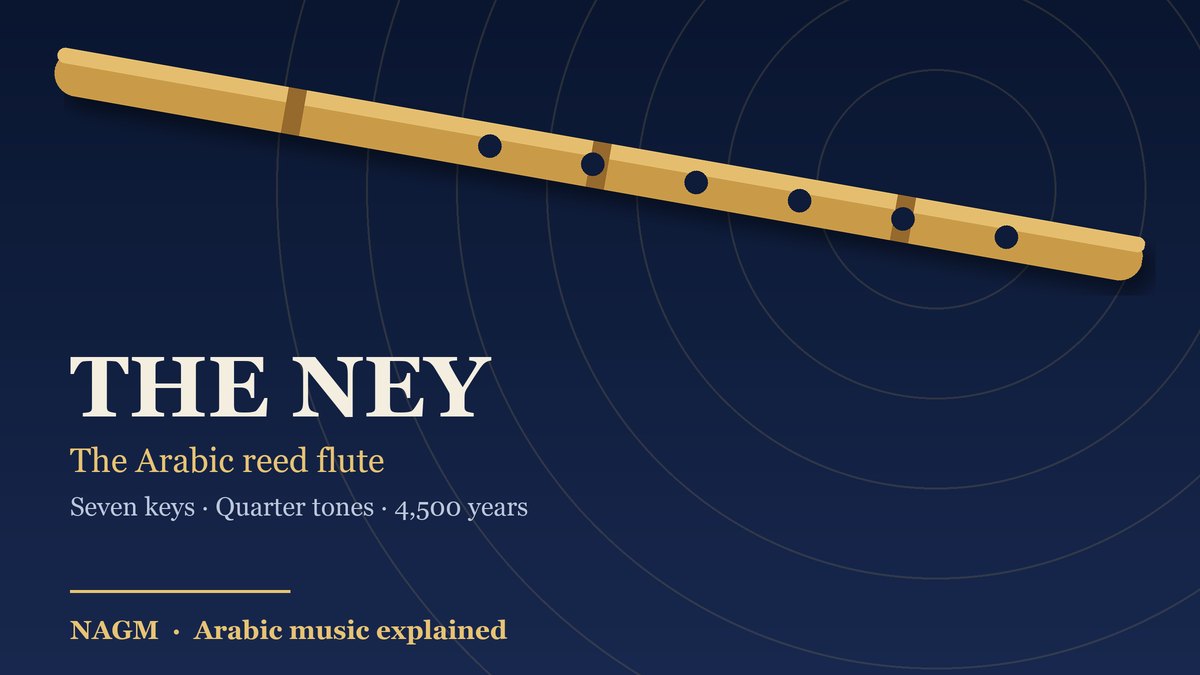
The short answer: the ney is an end-blown flute made from hollow cane or giant reed. According to Wikipedia's article on the instrument it has been played for over 4,500 years, going back to ancient Egypt, and it appears in Kurdish, Persian, Turkish, Jewish, Arab and Egyptian music. The Arabic version has no mouthpiece, normally has six finger holes on the front and one thumb hole at the back, and can slide between notes in the small steps that Arabic maqam music uses. This guide explains how it works, how it differs from its cousin the kawala, and how to start listening.
What a ney is made of
A traditional ney is a length of hollow cane. Wikipedia describes it as five or six finger holes plus a thumb hole, and says the Persian ney typically has six holes in total, one at the back, while Arabic and Turkish neys normally have seven: six on the front and a thumb hole behind. Modern neys may also be made of metal or plastic tubing.
The Arabic ney is played without any mouthpiece. The player rests the open end of the tube against the lips and blows across the edge. By contrast, the Turkish ney sometimes carries a brass, horn or plastic mouthpiece on the top that protects the wood and gives a better edge to blow on. A skilled player is called a neyzen.
Why it sounds the way it does
Much of the ney's character comes from what happens between the notes. Wikipedia notes that the intervals between the holes can be minor and major seconds as well as microtonal intervals of roughly three quarter tones, which a Western-trained ear might call neutral seconds. On top of that, players reach microtones and broader pitch bends by partially covering holes, changing the embouchure (the way the lips are shaped) or changing the angle at which they blow.
That flexibility is the reason the ney sits so comfortably in maqam music. If the term is new, our maqam beginner guide explains the modes and the quarter-tone steps that give them their color. The same pitch inflections matter in the taqsim, the improvised passage in which a soloist explores a scale before a piece begins. Wikipedia describes microtonal inflection as common and crucial to taqsim traditions.
The seven ney keys
One thing that surprises newcomers is that a single ney plays in one range, so players often own several. In the Egyptian and Arabic system, Wikipedia lists seven common ranges, named after Arabic note names rather than maqams:
- Rast: the longest and lowest, roughly equal to C in Western equal temperament
- Dukah: in D, and the most common
- Busalik: in E
- Jaharka: in F
- Nawa: in G
- Hussayni: in A
- Ajam: in B or B-flat
Advanced players typically own a set of several neys. The same source says it is possible, but difficult, to play fully chromatically on any one instrument, and that a highly skilled neyzen can reach more than three octaves. It also points out that the extreme low range is awkward: the fingering becomes quite complex and the move from the first octave to the second is not smooth.
Ney versus kawala
The ney is often confused with the kawala (also called salamiya), another end-blown cane flute used in Arabic music. Wikipedia lists three practical differences:
- The kawala has six finger holes and no hole at the back, whereas the ney has seven including the thumb hole.
- The kawala comes in up to nine sizes, depending on the maqam.
- The kawala is described as having its origin as a shepherd's tool for guiding a flock, and is most often played today at religious festivals and weddings, with a basis in Egyptian folk melodies.
The two sound close to each other, so if you are unsure which one is playing, check the track notes or the video title.
The ney in poetry and Sufi tradition
The reed has a special place in Persian literature. The 13th-century poet Jalal ad-Din Rumi opens his great poem the Masnavi with a reed that sings of separation. Wikipedia quotes the first lines in translation: "Listen to the reed and the tale it tells, how it sings of separation." The Mevlevi Order, a Sufi order from Konya in Turkey, was founded by Rumi's followers. That connection is a big reason the flute is so strongly associated with longing and spiritual music, and why a ney can sound "sad" to listeners who have heard it used this way. If you enjoy the link between poetry and sound, Arabic poetry in song follows the same thread in the Arab world.
How to start listening
- Begin with a solo taqsim. With one instrument and no singing, you can hear how the player moves between the pitches and how long a note is held. The demonstration video above shows a Turkish ney and an Egyptian nay side by side.
- Listen for the breath. Because there is no mouthpiece, you will hear air in the tone. That is normal, and part of the sound rather than a flaw.
- Follow the pitch bends. Notice where a note sags or lifts slightly. Those are the partial hole coverings and angle changes described above.
- Then hear it in an ensemble. The ney often joins the oud, qanun and percussion. Our guides to the main Arabic instruments, the qanun and darbuka rhythms show what each of them adds, and Arabic music genres explained places the styles in context.
If you want to try playing one
Making a steady tone on any end-blown flute without a mouthpiece takes practice, and the ney is no exception, so expect early sessions to be mostly air. Because the Dukah (D) is the most common range, it is the one you are most likely to find in beginner material. For a book-length introduction, Wikipedia lists Mahmoud Effat's Beginner's Guide to the Nay, translated by Jon Friesen from the 1968 Arabic original and published by Pitchphork Music in 2005. If you would rather start with a string instrument, our oud for beginners guide covers a first-week routine.
Sources
Instrument facts (age, construction, holes, mouthpiece, microtones, ranges, kawala comparison) come from Wikipedia's articles on the Ney and the Kawala, checked on 6 November 2026. The Rumi and Mevlevi details come from Wikipedia's articles on Rumi and the Mevlevi Order. Wikipedia is a starting point, so check the references at the foot of each page before quoting or teaching from them. The embedded video is a third-party demonstration; we do not control its content.