Search for "Arabic music" and you get a playlist that jumps from a 1950s orchestra to a distorted Cairo street anthem in under a minute. That is not a mistake. "Arabic music" is not one genre. It is an umbrella for the music of a whole region, and the genres under it differ in instruments, language, mood and even in what a "song" is.
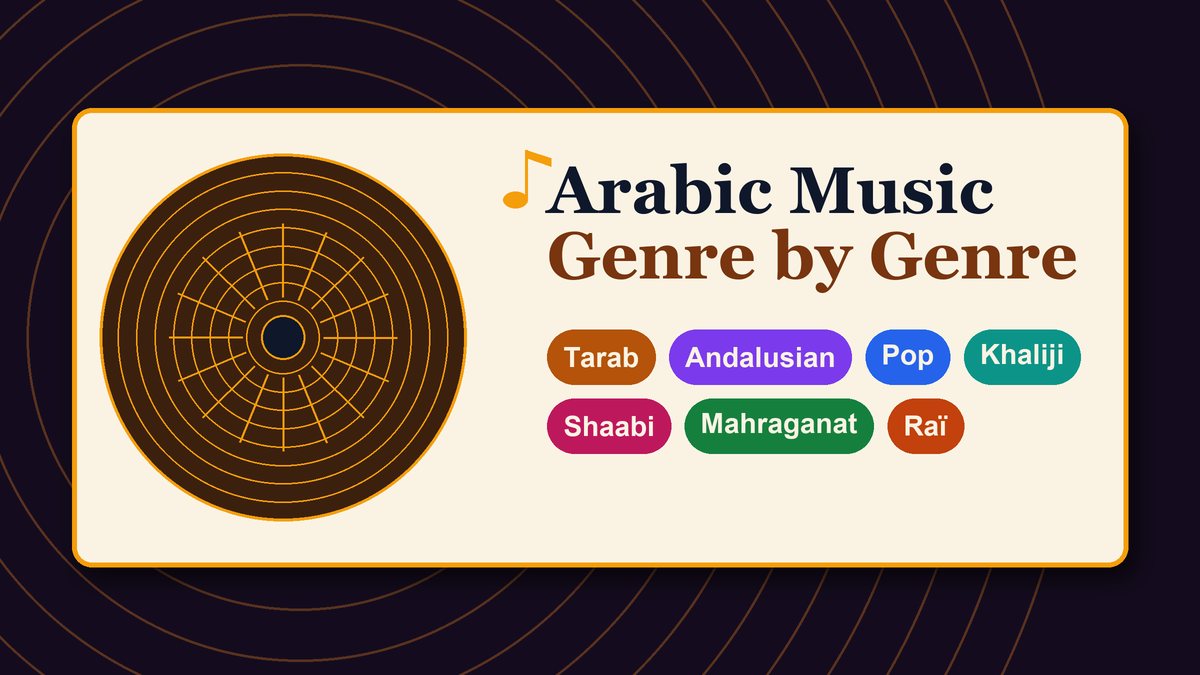
The short answer: the main families a new listener meets are tarab (urban classical), Arab-Andalusian songs, Arabic pop, Khaliji (Gulf), shaabi (Egyptian working-class pop), mahraganat (Egyptian electronic street music) and raï (Algerian pop). This guide explains each in plain English, names one artist to try, and ends with a simple order for listening.
The genres at a glance
- Tarab: the urban classical tradition of Cairo, Beirut, Aleppo and Damascus, built around emotional, improvised singing. Try Umm Kulthum.
- Arab-Andalusian music: sung poetry and suites from al-Andalus, kept alive mainly in North Africa. Try the muwashshah form.
- Arabic pop: studio-made love songs, mostly out of Cairo and Beirut. Try Amr Diab, Nancy Ajram or Elissa.
- Khaliji: "Gulf music", with oud, rebab and a lot of percussion. Try Abdul Majeed Abdullah.
- Shaabi: "music of the people" from Cairo's neighborhoods. Try Ahmed Adaweyah.
- Mahraganat: shaabi crossed with electronic dance music and hip-hop. Try Oka wi Ortega.
- Raï: Algerian pop from the port city of Oran. Try Khaled.
What "Arabic music" actually covers
According to Wikipedia, Arabic music is the music of the Arab world with all its diverse styles and genres, and each country and region has its own folk, classical and modern styles. The same page describes a long history of interaction with neighboring musical traditions, so the borders between genres are soft.
Two ideas hold much of it together. The first is the maqam system, the set of melodic modes that both composed and improvised music is built on. Maqams can use notes that fall between the piano keys, often called quarter tones, which is why some Arabic melodies sound "bent" to Western ears. If that is new to you, start with our beginner's guide to maqam. The second is language: most genres below are sung in a local dialect, so a Cairo shaabi song and a Gulf ballad can feel as different as Neapolitan and Norwegian folk songs.
Tarab: the classical heart
The word tarab (طرب) means roughly "enchantment". Wikipedia describes it as both a heightened emotional state and a style of music built to produce it. UCLA ethnomusicologist Ali Jihad Racy, in his 2003 book Making Music in the Arab World, called it a concept with no exact English equivalent, referring to both the music and the ecstatic feeling that goes with it. The audience matters as much as the performer: listeners call out and react, and the singer responds.
Tarab is tied to the cities of Cairo, Beirut, Aleppo and Damascus. Its most famous voice is Umm Kulthum, whose concerts could run for an hour per song. If you want to hear why, read why her classics last so long and how she held a nation together. Wikipedia's Arabic music article also credits Umm Kulthum and Abdel Halim Hafez, with composers Mohammed Abdel Wahab and Baligh Hamdi, as pioneers of adding Western instruments to Egyptian music between the 1940s and 1960s. That mix is where Arabic pop begins.
Arab-Andalusian music: poetry that traveled
The muwashshah is a sung poetic form that developed in al-Andalus (Islamic Iberia) in the late 10th and early 11th centuries, with a complex rhyme scheme and a closing verse, the kharja, that could be in a different language. The tradition survives today in North African forms such as the Andalusian nubah. Wikipedia notes that the Moroccan singer Zohra Al Fassiya was the first female singer to win wide popularity in the Maghreb, performing traditional Arab-Andalusian songs. For the history, see the music that survived the Alhambra.
Arabic pop: the radio and satellite sound
Arabic pop, or ughniyah ("song"), is mainly produced in Cairo, with Beirut as a second center, and it grew out of the Egyptian film industry. It combines pop melodies with regional Arabic styles, uses Western instruments such as electric guitars and keyboards next to the oud or darbuka, and, according to Wikipedia, the majority of songs are in a minor key with lyrics about longing, melancholy and love. Wikipedia also notes that Rotana, the largest company in the field, runs six TV channels, a record label and a roster of more than 100 Arab pop artists. If you want a gentle start, our playlist for people new to Arabic music mixes pop with older classics.
Khaliji: the sound of the Gulf
Khaliji (or Khaleeji) is the music of Eastern Arabia and the Gulf states. Wikipedia describes it as traditionally using the rebab, oud and other string instruments, sometimes the violin, with percussion such as the mirwas, tabl and duff. It began as a Bedouin tradition of poetry sung by a tribe's poet, with themes of honor, love and travel. Kuwaitis were the first commercial recording artists in the Gulf, and Iraq, Kuwait and Saudi Arabia shaped the modern genre; today it is mostly made by Iraqi, Emirati, Kuwaiti, Bahraini and Saudi artists. Our guide to the Khaliji sound goes further.
Shaabi: music of the neighborhood
Shaabi means "of the people". Wikipedia calls it a working-class Egyptian genre that evolved from baladi music and is found in the streets, at weddings and in everyday life. Its lyrics can be political, funny, or both. The first shaabi singer to become a star was Ahmed Adaweyah, whose first album in 1972 sold a million copies, according to the same source. If you want a sense of the energy, shaabi is the sound of a wedding where everyone knows the chorus.
Mahraganat: shaabi meets the laptop
Mahraganat (Arabic for "festivals") grew out of shaabi neighborhoods around 2006 and 2007, when wedding DJs began combining shaabi with electronic dance music, reggaeton, grime and rap, with heavy Auto-Tune. It spread first by phone, YouTube and SoundCloud, with no radio or TV airplay. It has been controversial: Wikipedia records that Egypt's musicians' union banned mahraganat in 2020 after a debate over the lyrics of a hit song. It also records that in 2014 a group of mahraganat DJs toured the Netherlands, one more link between Cairo's streets and Dutch club culture. If you like the electronic side, our post on electronic Arabic music and the piece on the Dutch EDM scene show how the two worlds sit side by side.
Raï: Algeria's pop revolution
Raï is a form of Algerian popular music whose origins date to the 1920s in the port city of Oran, where it arose among the poor. The name comes from the Algerian Arabic word for "opinion" or "advice", a word singers repeated while improvising the next line. Younger singers are called cheb (for women, cheba), meaning "young". Wikipedia says raï spread internationally through Algerian migration to Europe, and that it emerged as a major world music genre in the late 1980s.
The best-known name is Khaled. Wikipedia reports that his 1992 album Khaled, produced by Don Was, included the single "Didi", a major hit in Europe, the Arab world, and South and East Asia, and that it entered the top charts in France, Belgium and Spain. Here is the song from his official VEVO channel.
Because raï moved with migrants to France and Belgium, it is also a good bridge for readers who know the North African music of Western Europe. For a Dutch angle, see Moroccan-Dutch musicians rewriting the script.
Where to start: a simple listening order
- Start with what you already like. If you like pop, try Arabic pop; if you like dance music, try mahraganat or raï.
- Add one classic. Pick a single tarab song and listen for the audience as well as the singer. Our Fairuz listening guide is a gentler entry than a full Umm Kulthum concert.
- Learn the sounds behind it. The instruments guide and the darbuka rhythms guide help you hear what is being played.
- Follow the poetry. A translation of the lyrics changes how a song lands. Arabic poetry and song shows why.
A note on sources
The facts in this guide come from Wikipedia's articles on Arabic music, tarab, Arabic pop, Khaliji, shaabi, mahraganat, raï and Khaled, checked on 3 November 2026. Wikipedia is a starting point rather than a final authority, so for anything you plan to quote or teach, check the book and article references listed at the foot of each page. Racy's Making Music in the Arab World (Cambridge University Press, 2003) is the standard academic book on tarab.