If you have just bought an oud, or you are thinking about it, the first week can feel confusing. There are no frets, the strings come in pairs, and the tuning your teacher uses may not match the one on a video. This guide covers the basics in plain order: what you are holding, how to tune it, how to hold the pick, and a simple first routine.
Interest in the instrument is high right now. The Jerusalem Post reported on 24 October 2026 that the 27th annual Jerusalem International Oud Festival had opened, and many listeners who hear a live oud player for the first time want to try one themselves.
The short answer: tune the strings to a standard pattern with a clip-on tuner, hold a plastic pick (the risha) loosely between thumb and index finger, pluck both strings of each pair together, and start with open strings and one maqam, Rast, played very slowly. Your ear does the job that frets do on a guitar.
What you are holding
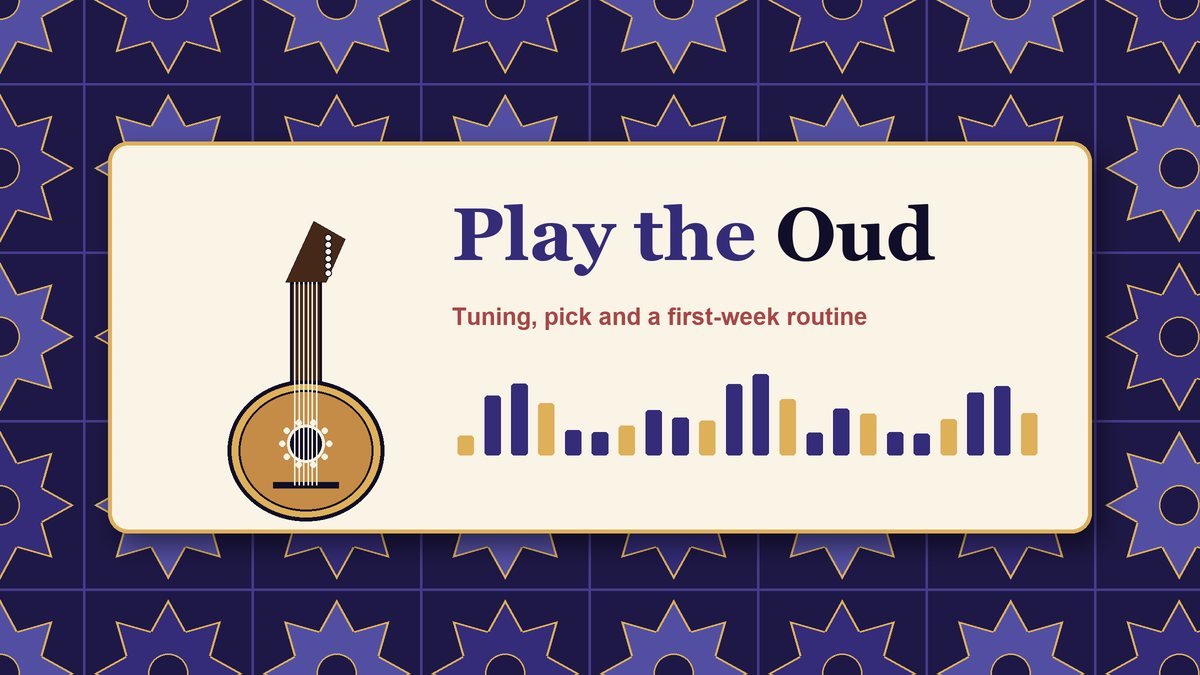
The oud is a pear-shaped, short-neck lute with no frets. Most ouds have 11 strings arranged in six courses: five pairs and one single bass string. Some models have five or seven courses instead. Because the neck is smooth, you place each finger by listening, which is why many teachers start with open strings before any scales.
If you have small hands, look at smaller models. A zenne oud, for example, usually has a scale length of about 55 to 57 cm, compared with roughly 60 to 62 cm on an Arabic oud and about 58.5 cm on a Turkish one. A shorter string length makes finger stretches easier. If you want the background first, our oud instrument history explains where the instrument comes from and how it differs from the European lute.
Choose a tuning (and stick to it)
There is more than one correct way to tune an oud. Which one you use depends on your tradition and your teacher. These are the common patterns, lowest string to highest:
- Older Arabic pattern: D2 G2 A2 D3 G3 C4
- Common modern Arabic tuning: C2 F2 A2 D3 G3 C4. Many current Arab players use this one on standard-size instruments.
- Higher Arabic tuning ("Modern Arabic Tuning"): F2 A2 D3 G3 C4 F4
- Turkish "Bolahenk" tuning: C#2 F#2 B2 E3 A3 D4. In this system the lowest C and F are set about a quarter tone higher than a normal C and F, so a standard tuner will show them as slightly sharp.
For a first instrument bought for Arabic music, C F A D G C is a sensible default. Ask the seller or your teacher which tuning the strings are made for, because string tension changes with pitch and a wrong choice can make the instrument sound weak or put strain on the neck.
Tuning tips that apply to every pattern:
- Use a clip-on or app tuner at first, then check each string against its neighbor by ear. Each step between courses is a perfect fourth, except the jump from F to A, which is a major third.
- Tune each pair in unison. If the two strings of a course beat against each other, one of them is off.
- Tune up to the note, not down from above. New strings stretch for days, so expect to retune often in the first week.
- Modern strings are made of silk, nylon, copper and silver-wound wire. Historically they were gut. Keep spare strings for the thinnest courses, which break first.
Holding the oud and the risha
Sit on a chair without arms, rest the round back against your body so it does not slide, and let the neck angle slightly upward. Your picking arm lies over the top edge. Your fretting hand should hang loose behind the neck, because the neck is short and there is no fret to press against.
The word risha means feather in Arabic. The plectrum was traditionally cut from an eagle's feather, but today it is most often plastic, and occasionally bone. A plastic risha, sold at any oud shop, is the right choice for a beginner. Hold it between the pad of your thumb and the side of your index finger, with only a small tip showing, and keep the wrist relaxed. Pluck both strings of the pair together, near the end of the sound hole, and aim for an even sound on the way down and on the way up. A stiff grip is the most common cause of a harsh, scratchy tone.
A simple first-week routine
Ten to fifteen minutes a day beats an hour once a week. Try this order:
- Open strings (3 minutes). Play each course on its own, slowly, down-up, listening for a clear, even tone. Stop when the sound is clean, not when the time runs out.
- Rhythm with the pick (3 minutes). Play one open string in steady eighth notes while you count. If you want a pattern to follow, our darbuka rhythms guide lists the four common ones, such as maqsum and baladi, and you can tap them with the pick as you play.
- One scale (5 minutes). Learn maqam Rast, described below.
- One short melody (3 minutes). Pick a simple folk tune you already know and find it by ear.
Why start with maqam Rast
Rast is regarded as the basic maqam in Arabic and Turkish music, much as the major scale is in Western music, though the two differ in detail. On C, the notes are C D E-half-flat F G A B-half-flat C. The "half-flat" is the quarter-tone feature that makes Arabic music sound the way it does: it falls between E-flat and E natural, and between B-flat and B natural.
On a fretless neck you slide your finger until that note sounds right. A tuner app helps at first: the third and seventh notes should read about halfway between two normal pitches. Exact pitch varies by region and by player, so use the tuner as a guide and train your ear by listening to recordings. For a clear explanation of how maqamat work, read our beginner's guide to maqam.
Common beginner mistakes
- Skipping tuning. A detuned oud makes every exercise sound wrong, and you learn the wrong pitches.
- Gripping the pick too hard. Relax your hand and let the wrist move.
- Treating half-flats as mistakes. They are part of the maqam. Do not "correct" them to the nearest piano note.
- Learning scales without listening. Play along with a recording of a taqsim (an improvised solo) now and then, even if you only follow the tonic note.
- Buying the cheapest instrument available. A poorly set-up oud with high string action can discourage you. If you can, try a few before you buy or ask a teacher to check it.
To hear the instrument in context, our beginner's guide to Arabic instruments shows how the oud sits with the qanun, ney and riq in a traditional ensemble, and the playlist for people new to Arabic music is a good place to find players to copy.
Sources
- The Jerusalem Post: Oud of this world: The 27th annual Jerusalem Int'l Oud Festival raises curtains (24 October 2026)
- Wikipedia: Oud (strings, tunings, risha, zenne oud) and Rast (accessed 29 October 2026)
- CBC Music (YouTube): intro oud lesson with Demetrios Petsalakis