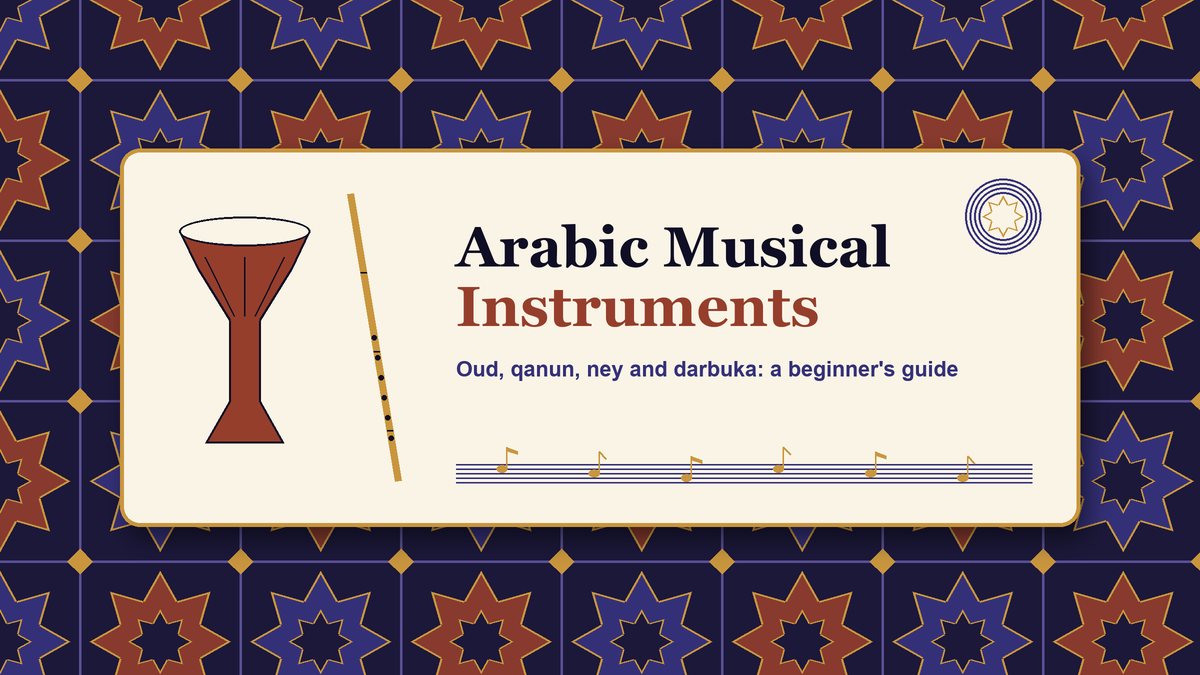
Classic Arabic music is built on a small, close-knit group of instruments. Learn to recognize six of them, the oud, qanun, ney, violin, riq and darbuka, and you can pick out almost every sound in a recording by Umm Kulthum, Fairuz or a modern Cairo orchestra. This guide explains what each instrument looks like, how it is played, what to listen for and which ones are realistic for a beginner to learn.
The quick answer: the oud is the fretless lute at the heart of the music, the qanun is a plucked zither that can tune notes between the piano keys, the ney is a breathy reed flute, and the darbuka is the goblet drum that drives the rhythm. Together with the violin and the riq (a small frame drum with jingles) they form the takht, the traditional Arabic chamber ensemble.
The takht: one small band, six jobs
Before looking at single instruments, it helps to know how they work together. In Egypt, Syria, Lebanon, Palestine and Jordan, the classic ensemble is called the takht. It usually combines the oud, the qanun, a bowed string instrument (originally the kamanjah, now usually the violin), the ney, the riq and the darbuka. A takht is small, often two to five players. A larger version with eight or more musicians is called a firqa.
The melody players do not split into harmony parts the way a Western string quartet does. They play the same tune at the same time, each decorating it in its own way. Musicologists call this heterophony. That is why a takht sounds thick and shimmering rather than chordal, and why each instrument has room for short solo improvisations called taqasim.
Those melodies follow the maqam system, the Arabic family of modes, some of which use intervals smaller than a Western half step. If maqam is new to you, start with our beginner's guide to maqam. It explains why several of the instruments below are built the way they are.
Oud: the fretless lute
What it looks like: a pear-shaped body with a rounded back, a short neck bent back at the pegbox, and usually 11 strings arranged in six courses (five pairs plus a single bass string). Some models have five or seven courses.
How it is played: with a long, flexible plectrum called a risha. The neck has no frets, so the player can slide into notes and place pitches exactly where a maqam needs them.
What to listen for: a warm, round, slightly percussive tone that often opens a song with a solo taqsim. When a melody bends smoothly between notes, it is very often the oud.
The oud is also the ancestor of the European lute; the word "lute" comes from the Arabic al-oud. We tell that story in detail in The Oud: Where European and Arabic Music Share an Ancestor, so here we stick to what a listener or learner needs.
Qanun: the zither with pitch levers
What it looks like: a flat, trapezoid-shaped box laid across the player's lap, with dozens of strings running across it. Strings are grouped in courses of three, and instruments typically have around 26 courses. The bridge rests on panels of fish skin, which shapes its bright, ringing tone.
How it is played: the player plucks with two small picks, one per hand, often doubling the melody in octaves. The clever part sits under each course: small metal levers called mandals. Flipping a lever changes the effective string length and nudges the pitch up or down. On Arabic qanuns the levers are set to give quarter tones, so a player can move to a new maqam in the middle of a piece by flicking levers with the left hand while playing.
What to listen for: fast, harp-like runs and cascading trills that sparkle above the rest of the ensemble. A standard range of about three and a half octaves lets the qanun cover both bass and melody.
The video below shows a qanun taqsim by the takht of the Michigan Arab Orchestra. Watch the player's left hand: the quick movements near the edge of the instrument are the levers changing pitch.
Ney: the reed flute
What it looks like: a simple tube of cane or giant reed. Arabic and Turkish neys normally have seven holes, six on the front and one thumb hole on the back. The Arabic ney has no mouthpiece at all.
How it is played: the ney is end-blown. The player rests the top rim against the lips and directs a thin stream of air across the edge at an angle. Partly covering holes, changing the blowing angle and turning the instrument let the player shade pitches into the microtones that maqam needs.
What to listen for: a breathy, airy, almost vocal tone with audible breath. In several traditions it is the only wind instrument in the group, and it is closely linked to Sufi devotional music.
One practical detail surprises beginners: neys come in different lengths, each named after an Arabic note. In the Egyptian and Arabic system the common sizes run from Rast (the longest and lowest, roughly a C) through Dukah (roughly D, the most common) up to Ajam. Advanced players own a set so they can match the singer's key. The ney is also very old: reed flutes of this kind go back to ancient Egypt, which makes it one of the oldest instruments still in everyday use.
Violin: the borrowed voice
The Western violin has largely taken the place of the older bowed kamanjah in Arabic ensembles. Arab violinists often use a different tuning from classical players and lean on slides and ornaments, so the violin sounds less like an orchestra section and more like a second singer shadowing the vocal line. In the big Egyptian orchestras of the 20th century a whole section of violins carried this role: it is the sweeping string sound behind Umm Kulthum. Our profile of Umm Kulthum, the voice of a century is a good starting point for that sound.
Riq: the timekeeper
What it looks like: a small, round frame drum with a thin skin head and pairs of small brass cymbals set into the wooden frame. It looks like a tambourine but is played with far more control.
How it is played: held upright in one hand. The player taps the skin for low and high strokes and shakes or flicks the frame to make the cymbals shiver.
What to listen for: crisp, jingling patterns that mark the rhythmic cycle. In a classical takht the riq traditionally keeps time for everyone, which is why its player sits close to the singer and the soloists.
Darbuka: the goblet drum
What it looks like: a goblet-shaped drum with a single head, made of clay, metal or cast aluminum. It goes by many names, including darbuka, tabla (in Egypt), doumbek and tarabuka. The name darbuka is usually traced to the Arabic root darb, "to strike."
How it is played: held under the arm or across the thigh. There are three core sounds: the dum (a deep bass tone from striking near the center), the tak (a sharp high tone at the rim with the fingertips) and the ka (a tak played with the other hand). Egyptian-style drums have a rounded rim that allows fast rolls; Turkish-style drums expose the edge of the head for finger-snapping techniques.
What to listen for: the pulse under almost all popular Arabic music and dance. The best-known rhythm, maqsum, is often counted as "dum-tak, -tak, dum, -tak." Once you can hear it you will notice it everywhere, from wedding songs to modern pop.
Other instruments you will hear
- Buzuq: a long-necked lute with movable frets and metal strings, played with a plectrum. It is a Levantine folk instrument rather than a classical one, but it became a key sound in the Rahbani brothers' songs for Fairuz.
- Mijwiz: a double-pipe reed instrument from the Levant, played with circular breathing for a nonstop, buzzing tone. It is the classic sound of dabke line dances.
- Rebab: one of the earliest known bowed instruments, named no later than the 8th century and still heard in folk and North African traditions.
- Daf and bendir: larger frame drums used in folk, devotional and Sufi music.
Which instrument should a beginner learn?
There is no single right answer, but each instrument has a very different learning curve.
- Darbuka: the easiest start. Drums are portable and comparatively affordable, and you can play basic rhythms like maqsum within days. It also trains your ear for the rhythms behind every other instrument.
- Oud: the classic choice for melody. Guitar players can transfer a lot of right-hand technique, but the fretless neck means you must train your ear to find notes, including quarter tones. A teacher or structured lessons help a lot in the first months.
- Ney: hard first steps. Simply getting a clear note can take weeks because there is no mouthpiece to guide the airstream. The instrument itself is simple and inexpensive, so it suits patient learners.
- Qanun: a big commitment. It is larger, more expensive and slow to tune with that many strings and levers. It is usually a second instrument for serious students.
If you live outside the Arab world, community Arabic music ensembles, university world music programs and online lessons from established players are the usual routes. Listen a lot first: recognizing each instrument by ear makes any lessons more rewarding.
A five-minute listening exercise
Put on any classic Egyptian song or a live takht performance and try this:
- Find the pulse first: the low dum of the darbuka and the jingles of the riq.
- Listen for the bright runs above the melody: that is the qanun.
- Listen for the warm, plucked notes that bend: the oud.
- Listen for a breathy, airy line, often in quiet passages: the ney.
- Notice the singing, sliding strings shadowing the voice: the violin.
Concerts are an even better classroom. The Arab Music Festival at the Cairo Opera House runs every autumn; see our listener's guide to the 2026 festival. For how these instruments shaped European music, read our piece on Arabic classical music and al-Andalus, and for a Dutch counterpoint, our guide to traditional Dutch instruments.
Frequently asked questions
What are the main instruments in Arabic music?
The core classical set is the oud (fretless lute), qanun (plucked zither), ney (reed flute), violin, riq (frame drum with jingles) and darbuka (goblet drum). Together they form the takht ensemble.
What is the difference between a darbuka and a doumbek?
They are the same instrument, a goblet drum, under different names. Darbuka and tabla are common Arabic names, doumbek is common in English, and tarabuka is another regional name. Egyptian- and Turkish-style drums differ mainly in the shape of the rim.
Which Arabic instruments can play quarter tones?
The oud and violin can, because they have no frets. The ney can by shading holes and changing the blowing angle. The qanun uses small levers called mandals to retune each course while playing.
Is the oud hard to learn?
The basics are approachable, especially for guitar players, but the fretless neck makes accurate pitch a matter of ear training. Most learners benefit from a teacher and from learning a few maqamat early on.
What is a takht?
A takht is the small traditional Arabic ensemble, usually two to five musicians playing oud, qanun, violin, ney, riq and darbuka, sometimes with a singer and a small chorus. A larger ensemble of eight or more is called a firqa.
Sources
- Wikipedia: Takht (music), Oud, Qanun (instrument), Ney, Goblet drum, Buzuq, Mijwiz, Rebab (accessed 25 October 2026)
- Video: qanun taqsim by the Michigan Arab Orchestra takht, published on Michael Ibrahim's YouTube channel