If you have listened to Umm Kulthum, Fairuz or almost any Arabic orchestra, you have heard the qanun even if you did not notice it. It is the shimmering, harp-like sound that runs through the arrangement like water: quick plucked runs, rippling tremolos, and ornaments that slide between the notes of a piano.
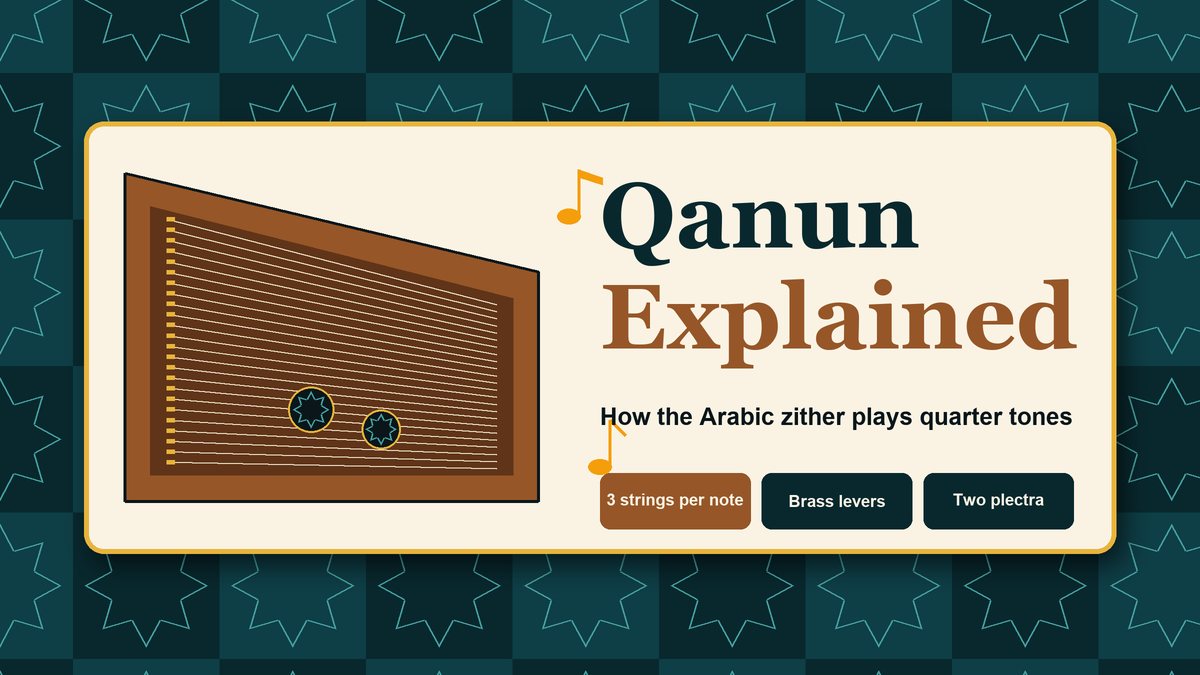
The short answer: the qanun (also spelled kanun or qanoon) is a trapezoid-shaped zither, played flat on the lap or a small table, with groups of three strings per note and a row of small brass levers that let the player retune each note by a fraction of a tone while performing. It is one of the four main melodic instruments of the traditional Arabic ensemble, alongside the oud, the nay (reed flute) and the violin.
What a qanun looks like and how it is built
The body is a flat, thin wooden box shaped like a right-angled trapezoid. According to Wikipedia, Arabic qanuns usually have five skin-covered windows that carry one long bridge on five arched supports, while the slightly smaller Turkish kanun uses four. The extra room lets Arabic instruments reach lower bass and higher treble strings. MaqamWorld adds that the skin is goat or fish skin, and that the bridge sits on the right-hand side, with the strings running left over the levers to tuning pegs.
- Strings in threes. Each note is sounded by a course of three strings tuned together, which gives the qanun its full, slightly chorused tone. Wikipedia says Turkish kanuns generally have 26 courses, so 78 strings; MaqamWorld describes an Arabic instrument with 81 strings. Counts vary by maker.
- Two plectra. The player wears a pick on the index finger of each hand (Wikipedia mentions tortoiseshell picks, or the fingernails) and plucks with both hands at once, which is why fast scale runs and tremolos are so easy to get.
- Sound holes. The ornamental roses on the soundboard are called kafes, and their position differs between Turkish and Arabic instruments.
- Range. Wikipedia gives a standard range of three and a half octaves, A2 to E6, which Arabic designs can extend down to F2 and up to G6.
The levers: how one string plays quarter tones
Arabic music uses scales (maqamat) that include intervals between the neighbouring keys of a piano. A fretless instrument like the oud or the violin can simply place a finger a little higher or lower. The qanun has fixed strings, so it solves the problem differently: a small brass lever, called a mandal, sits under each course at the left end. Flip it and the effective string length changes, nudging that note up or down slightly.
MaqamWorld describes how this works in practice. Because the instrument has only eight notes per octave, the player first sets the levers to build the scale of the opening maqam. To modulate to another maqam, they flip several levers back and forth with the left hand while the right hand keeps playing. For a quick change, they can press a left-thumb fingernail on a string to raise it for a moment.
The levers are a fairly modern improvement. Wikipedia reports, citing the Turkish musicologist Rauf Yekta, that mandal technology was introduced about 30 years before his 1922 monograph, so roughly the 1890s. Before that, a player had to use a thumbnail for every alteration, which made quick modulations laborious.
A caveat worth knowing
Modern Arabic qanuns are set up in 24 equal steps to the octave, which means quarter tones. Wikipedia notes that this is a source of debate: recordings of traditional performers suggest that real maqam intonation is often more fluid than any equal division, so a qanun can sound slightly different from a perfectly tuned oud or nay playing the same maqam. Some performers went further: the late Swiss-French qanun player Julien Jalâl Eddine Weiss, for example, had prototypes built from simple whole-number intervals for that reason. If you hear a qanun and an oud sit a hair apart on one note, this is why, and it is part of the character rather than a mistake.
Where the qanun comes from
The name comes from the Greek kanōn, "rule" or "law", and MaqamWorld notes that the word means "law" in Arabic as well. It suggests the qanun was the instrument that laid down the pitch for other instruments and singers. MaqamWorld calls it a descendant of the old Egyptian harp and says it has been central to Arabic music since the 10th century. Wikipedia traces one root further back, to a stringed instrument shown on a 19th-century BC ivory box found at Nimrud in ancient Assyria. Sources differ on the early story, so it is safest to say the qanun is very old and has changed a lot, with the levers a late addition.
Today it is played in the Arab world, Turkey, Armenia, Iran, Greece and North Africa, with its own regional versions in each.
Hear it: what to listen for
This short video from the qanun player Maya Youssef's channel compares the Arabic and Turkish qanun, the two main regional types described above.
Then try these three things when you listen to any Arabic recording:
- The fast plucked runs. A two-handed run up and down the strings, often leading into a phrase from the singer, is the qanun's signature.
- The tremolo. Rapid repeated plucking on one course produces a sustained shimmer, because the instrument cannot hold a note the way a violin does.
- The solo improvisation. In a taqsim, a free-time improvisation in one maqam, the qanun's player moves the levers to wander from one scale to another. Our beginner's guide to maqam explains what the player is following.
Two names make a good start. MaqamWorld calls Muhammad Abdu Saleh Umm Kulthum's qanun player for decades, so you can hear him in the long concerts discussed in our piece on why Umm Kulthum's songs last an hour. For a modern solo voice, try Maya Youssef, a Syrian musician based in the UK who, according to Wikipedia, has performed at the BBC Proms and WOMAD.
Qanun, oud and piano: a quick comparison
- Oud: fretless, one note at a time on a string, bends pitch with the finger. See our oud for beginners guide and the history of the oud.
- Qanun: one string course per note, pitch changed with levers, plucked with two picks, so it can play fast passages and wide chords.
- Piano: fixed 12-note tuning, which cannot play quarter tones unless modified.
For the full line-up of the ensemble, including the nay, violin and riq, read our beginner's guide to Arabic musical instruments.
Sources
- MaqamWorld: Qanun and Arabic Musical Instruments (construction, levers, Muhammad Abdu Saleh, ensemble roles; accessed 1 November 2026)
- Wikipedia: Qanun (instrument) (regional variants, range, mandals, tuning debate; accessed 1 November 2026)
- Wikipedia: Maya Youssef (accessed 1 November 2026)
- Maya Youssef Music (YouTube): Arabic vs. Turkish Qanun