Type "Umm Kulthum English subtitles" into a search bar and the problem shows up at once. Her classic songs run close to an hour, they are sung in Arabic, and they were made for live radio concerts decades before anyone thought about subtitle tracks. Nobody has put out one tidy, official English-subtitled collection.
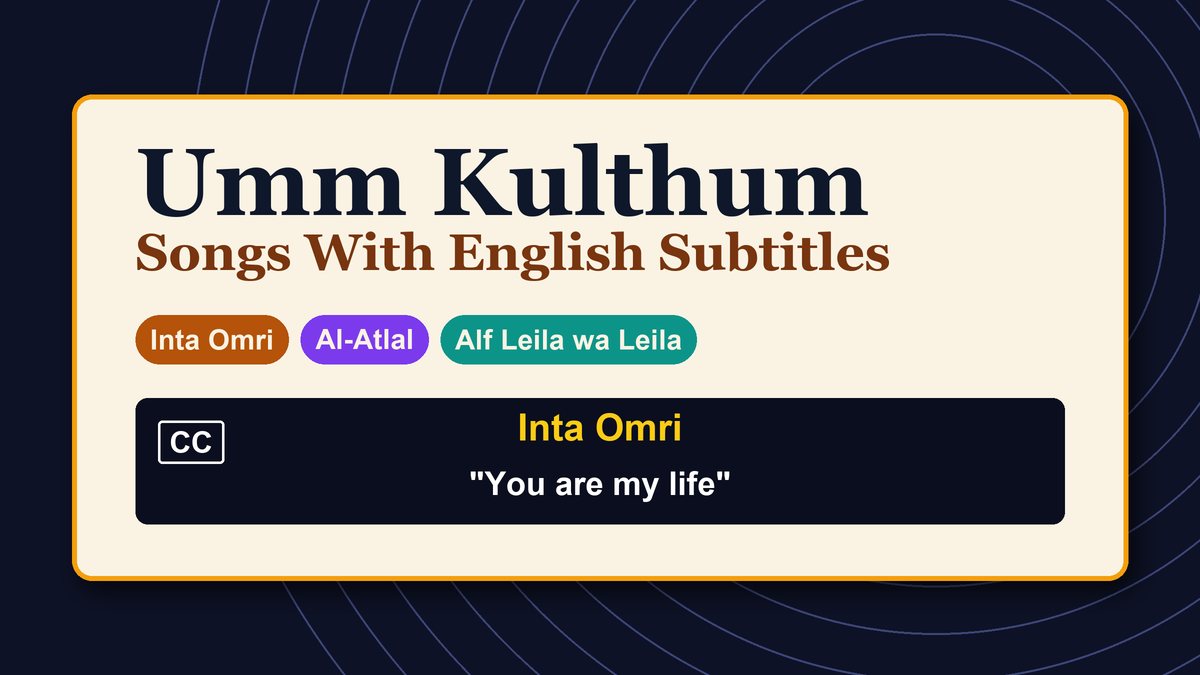
The short answer: we could not find an official English-subtitled catalog of her concerts. What works is a three-part approach: watch a documentary that was made with English subtitles, use uploader-added captions on single videos with a pinch of salt, and follow one of three well-documented songs, "Inta Omri", "Al-Atlal" or "Alf Leila wa Leila", with a written translation next to the recording. This guide shows how, and what to watch out for.
Why subtitles are hard for these songs
Three things get in the way, and knowing them saves a lot of frustration.
- Length. "Inta Omri" is listed at 59 minutes 11 seconds on its original Sono Cairo release, according to Wikipedia. A subtitle track either covers a short excerpt or has to follow a very long performance. Our song length guide explains why the songs run so long.
- Two kinds of Arabic. Wikipedia lists the language of "Inta Omri" as Egyptian Arabic. "Al-Atlal" is different: its words were adapted from two poems by Ibrahim Nagi, written in classical Arabic. A translator has to handle everyday dialect in one song and formal poetry in the other, and the two jobs are not alike.
- Translation is a choice. Poetry can be translated word for word or for feeling. Two honest English versions of the same line can look quite different, so do not be alarmed when two websites disagree.
Route 1: the documentary with English subtitles
The easiest place to hear Umm Kulthum's story in English is the documentary Umm Kulthum: A Voice Like Egypt (1996) by Michal Goldman. The University of Wisconsin-Madison library catalog describes it as in Arabic with English subtitles and English narration, and the Middle East Center at the University of Pennsylvania lists it in its lending library as narrated by Omar Sharif. Variety's 1996 review called it the first documentary in English on the singer and "an accessible intro".
It is a film rather than a concert, but it shows her village, Cairo's cafés and the audience, and it is a good warm-up before a one-hour song. Library and university lending catalogs are the safest way to find a legitimate copy. We have not linked to any unofficial upload.
Route 2: captions on single videos
On YouTube, open the video, press the settings gear and look under Subtitles/CC. A few things to check:
- Is English listed as a real track? If the uploader added captions, you will see English and often Arabic. If you only see an "auto-translate" option, the English is machine output.
- Test a minute. Read the English for 60 seconds while the singer is mid-phrase. If the lines keep changing every few seconds and make little sense, the track is probably a machine translation of automatic Arabic captions.
- Search the Arabic title too. The song names are written إنت عمري (Inta Omri), الأطلال (Al-Atlal) and ألف ليلة وليلة (Alf Leila wa Leila). Spellings in English vary a lot ("Enta Omri", "Ente Omry", "Al Atlal"), so try more than one.
Here is a recording of "Inta Omri" to try the method on. We have not checked whether this upload carries English captions, so run the test above.
Treat machine translation as a rough guide only. It tends to flatten poetry and dialect, so compare it with a human-written translation when the meaning matters.
Route 3: three songs to follow with a translation
If you want to understand the words, pick one song and read a written translation while you listen. These three are well documented, so it is easy to check a translation against the facts.
"Inta Omri" ("You Are My Life"): the easiest to follow
Composed by Mohamed Abdel Wahab with words by the poet Ahmad Shafik Kamel, sung in Egyptian Arabic and set in maqam Kurd, which Wikipedia says is usually used to portray feelings of freedom, romance and gentleness. Wikipedia also notes that it was her first song composed by Abdel Wahab. As the title says, it speaks to a beloved. Because the language is everyday Egyptian Arabic, it is the best first pick if you want to match what you hear with what you read.
"Al-Atlal" ("The Ruins"): the poem
Released in 1966 with music by Riad Al Sunbati. The song's words were adapted from two poems by Ibrahim Nagi, "Al-Atlal" and "Al-Wadaa" ("The Parting"), and Wikipedia notes that it was recorded 13 years after the poet's death. The poem it comes from is inspired by the qasida and can be read in three parts: a speaker standing in the ruins of a deserted camp remembers a lost love; a journey through the desert follows, including a rebuke to an ill-tempered camel; and finally he arrives at a new camp. Wikipedia's translation of one line gives the flavor: "You my heart do not ask where love has gone. It was a mirage that dispersed." Because the text is classical poetry, a written translation with notes helps more here than captions do. See also Arabic poetry and song.
"Alf Leila wa Leila" ("A Thousand and One Nights"): for later
Words by Morsi Gamil Aziz, music by Baligh Hamdi, first performed in 1969. The title borrows the name of the famous story collection. We have not verified a stanza-by-stanza account of its text, so use a translation and the song's documented background rather than guessing at meanings. Save it for when you are comfortable with the style.
A simple plan
- Watch the documentary, or part of it, for the story and the audience.
- Read a translation of "Inta Omri" first, then listen with the text beside you. Do not try to match every line: the singer repeats and varies phrases, so let the translation act as a map.
- Move on to "Al-Atlal" once you know the rhythm of how she sings. Read the poem's three-part outline before you press play.
- Learn what you are hearing. Our maqam guide explains the modes, and her profile covers the career. If you want a gentler first singer, try the Fairuz listening guide.
If you are still deciding what Arabic music to explore, Arabic music genres explained puts tarab, the tradition she belongs to, in context.
Sources
Song and biography facts come from Wikipedia's articles on Umm Kulthum, "Inta Omri", "Al-Atlal" and "Alf Leila wa Leila", checked on 4 November 2026; the Alf Leila wa Leila article carries a maintenance notice about its sourcing, so we kept to basic credits there. The documentary details come from the University of Wisconsin-Madison Libraries catalog record, the University of Pennsylvania Middle East Center's media lending library page, and Variety's 1996 review. Wikipedia is a starting point, so check the references at the foot of each page before quoting or teaching from them.