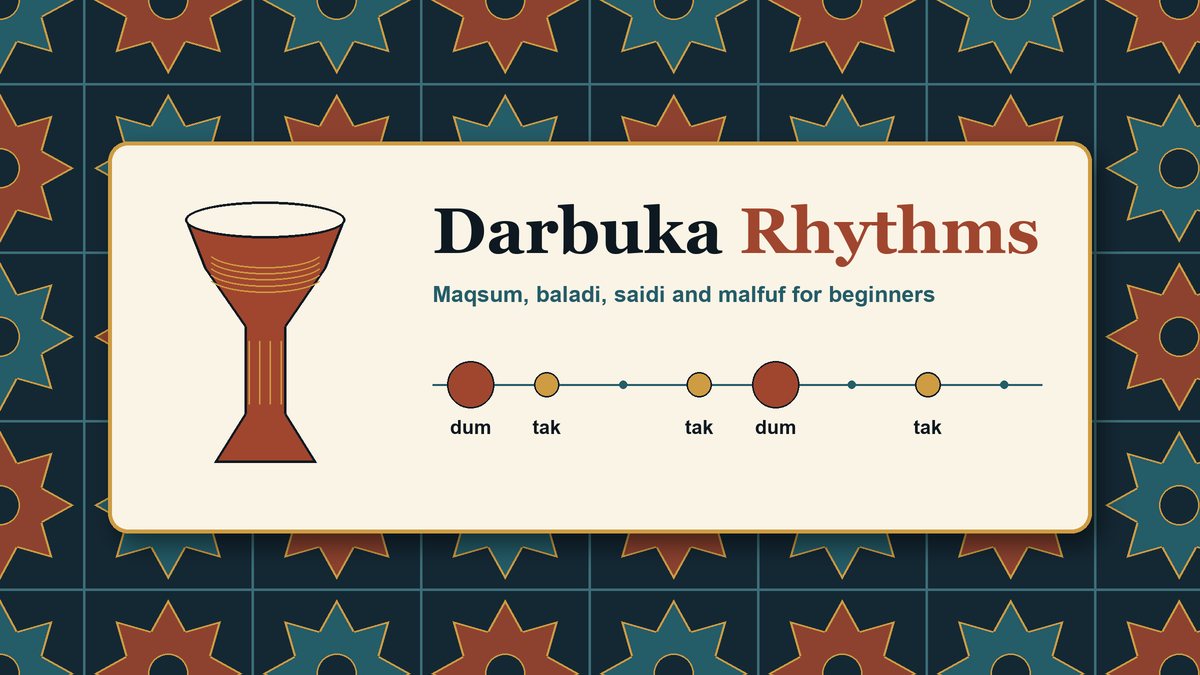
Almost every Arabic song you will hear at a wedding, on Egyptian radio or in a belly dance class sits on one of a handful of rhythmic cycles. Learn four of them on the darbuka, maqsum, baladi, saidi and malfuf, and you can play along with a surprising share of popular Arabic music. This guide shows each rhythm as a simple count, explains the two basic sounds you need, and gives a practice routine that works even if you have never touched a drum.
The short version: Arabic rhythms are built from two sounds, a deep dum and a sharp tak. Maqsum is the all-purpose 4/4 groove, baladi is the same idea with a heavier double dum at the start, saidi moves the weight to the middle of the bar, and malfuf is a quick two-beat pulse used to drive and link sections.
What Arabic rhythms are called: the iqa'
In Arabic music a rhythmic cycle is called an iqa' (plural iqa'at). Each one is a repeating pattern of dums and taks that fills one bar, or sometimes several. Maqam World, the widely used reference site on Arabic music theory, lists more than forty of them, from the short 2/4 malfuf to long classical cycles of 16 or 32 beats.
The written pattern is only a skeleton. In practice, drummers "flesh out" the skeleton with extra light strokes and ornaments, and how much they add depends on the style, the song and the player. That is good news for beginners: once the skeleton is solid, everything else is decoration you can add slowly.
Rhythm and melody also work as a pair. Just as a song can move from one maqam (melodic mode) to another, it can switch from one iqa' to another mid-song. If the melodic side is new to you, our beginner's guide to maqam covers it in plain language.
The sounds you need: dum, tak and ka
The darbuka (also called tabla, doumbek or tarabuka) is a goblet-shaped hand drum. For a full introduction to the drum and the instruments it plays with, see our beginner's guide to Arabic musical instruments. For rhythm practice you only need three strokes:
- Dum: the low, open bass tone. Strike the head between the center and the edge with the flat of your dominant hand's fingers and let the hand bounce off so the note rings.
- Tak: the high, dry sound. Flick the fingertips of your dominant hand against the edge of the head, close to the rim.
- Ka: the same edge sound played with the other hand. It is usually softer and is mostly used to fill the gaps between the main strokes.
Most right-handed players sit with the drum across the left thigh, tucked under the left arm, with the head facing to the right. If you do not have a drum yet, a tabletop or your knees will do: the flat of the hand for dum, fingertips for tak.
How to read the rhythms below
Each 4/4 pattern below is counted in eighth notes: 1 and 2 and 3 and 4 and. D means dum, T means tak, and a dot means silence, or a light ka once you are ready to fill the space. Say the syllables out loud while you clap or tap them. Drummers learn these rhythms by voice first, and it really does make them stick.
| Rhythm | 1 | & | 2 | & | 3 | & | 4 | & |
|---|---|---|---|---|---|---|---|---|
| Maqsum | D | T | · | T | D | · | T | · |
| Baladi | D | D | · | T | D | · | T | · |
| Saidi | D | T | · | D | D | · | T | · |
Maqsum: the rhythm to learn first
Count it: DUM tak . tak DUM . tak .
Maqam World calls maqsum "by far the most widely used" rhythm in Arabic music, and that is the best reason to start here. It is a steady, bouncy 4/4 that sits under classic Egyptian songs, Lebanese pop and modern dance tracks alike. Notice the shape: one dum at the start, a second dum on beat three, and taks dancing around them. The off-beat tak right after the first dum gives maqsum its forward lean.
Listen for it in: Ahmad Adaweya's "Ana Bahibb el-Gedid" and Fairuz's "Waraqu al-Asfar", both listed as maqsum examples by Maqam World. Long Umm Kulthum songs such as "Darit el-Ayyam" (1970, music by Mohammed Abdel Wahab) also use it in some sections. Our profile of Om Kalthoum explains why her concerts could stretch a single song past an hour.
Baladi: maqsum with a heavier start
Count it: DUM DUM . tak DUM . tak .
Compare baladi with maqsum and you will see only one change: the tak on "1-and" becomes a second dum. That small swap makes the groove feel heavier, earthier and more "street", which suits its name: baladi roughly means "of the country" or "local". It is also called masmoudi saghir ("little masmoudi"), to set it apart from the longer two-bar masmoudi kabir.
Because the two rhythms are so close, songs slide between maqsum and baladi all the time, and percussionists often blend them in one performance. If you can play maqsum, you can play baladi in five minutes. Maqam World's examples include Mohammed Abdel Wahab's instrumental "Aziza" (1955).
Saidi: the double dum in the middle
Count it: DUM tak . DUM DUM . tak .
Saidi comes from the Sa'id, the region of Upper (southern) Egypt, and Maqam World describes it as "lively and quintessentially Egyptian". The giveaway is the pair of dums in the middle of the bar, on "2-and" and "3". That double dum makes saidi feel like it is stomping or galloping, and it is the rhythm most associated with the Upper Egyptian stick dance (tahtib) and with the cane dance that belly dancers adapted from it.
Saidi trades places with maqsum and baladi freely within songs. Listen for it in: Abdel Halim Hafez's "Sawwah" (1966) and "Zayy el-Hawa" (1970), both composed by Baligh Hamdi.
Malfuf: the quick two-beat drive
Count it (2/4, in sixteenths: 1 e and a 2 e and a): DUM . . tak . . tak .
Malfuf (also called laff) is short: one dum and two taks spread unevenly across two beats, giving a 3 + 3 + 2 feel that keeps rolling forward. It is used mainly in folk and popular music, for fast passages, entrances and moments where the band wants momentum. Two bars of malfuf fill the same time as one bar of maqsum or baladi, so drummers switch between them easily.
Malfuf is also a great practice tool. Because it is so short, you can loop it fast and build speed and evenness in both hands. Maqam World lists Umm Kulthum's "Amal Hayati" (1965) and Fairuz's "Ya Dara Duri Fina" among its examples.
Two more rhythms you will meet soon
- Wahda: "wahda" means "one", for the single dum in each 4/4 bar. That leaves a lot of open space, which is why it became the main rhythm under vocal phrases in twentieth-century tarab singing: the singer can stretch and ornament freely over it.
- Ayyub: a fast, hypnotic 2/4 cycle often counted as "dum-ka-dum-tak". It is used in Sufi music and some folk and dance music, and in Egypt it is also called zar, after the women-led healing ceremony of the same name.
After these, the usual next steps are the two-bar masmoudi kabir (8/4), the slow belly dance favorite chiftetelli, and odd-meter classical cycles such as sama'i thaqil (10/8). The Gulf has its own rhythmic world as well; our guide to Khaliji music is a good starting point.
A 15-minute practice routine
- Sounds (3 minutes). Alternate four dums and four taks until both sound clean and even. A dum should ring, a tak should snap.
- Say it (2 minutes). Speak maqsum out loud in time with a metronome around 70 beats per minute, without the drum.
- Skeleton (5 minutes). Play maqsum, then baladi, then saidi, four bars each, cycling without stopping. Keep the tempo slow enough that you never hesitate.
- Fill in (3 minutes). Add soft ka strokes with your other hand on the empty dots. Keep them quieter than the main strokes.
- Play along (2 minutes). Put on a song from our playlist for people new to Arabic music and try to find which rhythm it uses.
Raise the metronome a few beats only when a rhythm feels easy at the current speed. Speed comes from evenness, not from pushing.
Common beginner mistakes
- Muffled dums. If your hand stays on the head, the bass dies. Let the hand bounce off.
- Taks that are too loud. The tak is crisp, not hard. Hitting harder usually makes it thinner and hurts your fingers.
- Rushing the rests. The gaps are part of the rhythm. In maqsum, the space before the second dum is what makes it groove.
- Filling too early. Ornaments only sound good on top of a steady skeleton. Learn the bare pattern first.
The best ear training is live music. If you get the chance, watch the percussionists at a concert such as the Arab Music Festival in Cairo: you will see them switch between these rhythms in real time.
Frequently asked questions
What is the easiest darbuka rhythm for beginners?
Maqsum is the usual first rhythm. It uses only two dums and three taks in a 4/4 bar, it is the most common rhythm in Arabic music, and baladi and saidi are small variations of it.
What is the difference between maqsum and baladi?
Only the second stroke changes. Maqsum goes dum, tak; baladi goes dum, dum. The extra dum makes baladi sound heavier and more grounded. The rest of the bar is the same.
What does dum and tak mean?
They are the names of the two basic drum sounds. Dum is the deep bass tone played near the center of the head; tak is the sharp, high sound played at the edge. Ka is an edge stroke with the other hand.
Which rhythm is used for belly dance?
Belly dance uses many rhythms, but maqsum, baladi, saidi and malfuf are the everyday ones. Saidi is closely linked with the cane dance, and slower pieces often use chiftetelli.
Do I need a teacher to learn darbuka?
You can learn the basic rhythms on your own with a metronome and recordings. A teacher helps most with clean technique, rolls and ornaments, and with feel in real songs.
Sources
- Maqam World: Arabic rhythmic cycles (iqa'), Maqsum, Baladi, Sa'idi, Malfuf, Wahda, Ayyub (accessed 26 October 2026)
- Wikipedia: Goblet drum (accessed 26 October 2026)
- Video: baladi lesson by Artem Uzunov, published on his YouTube channel