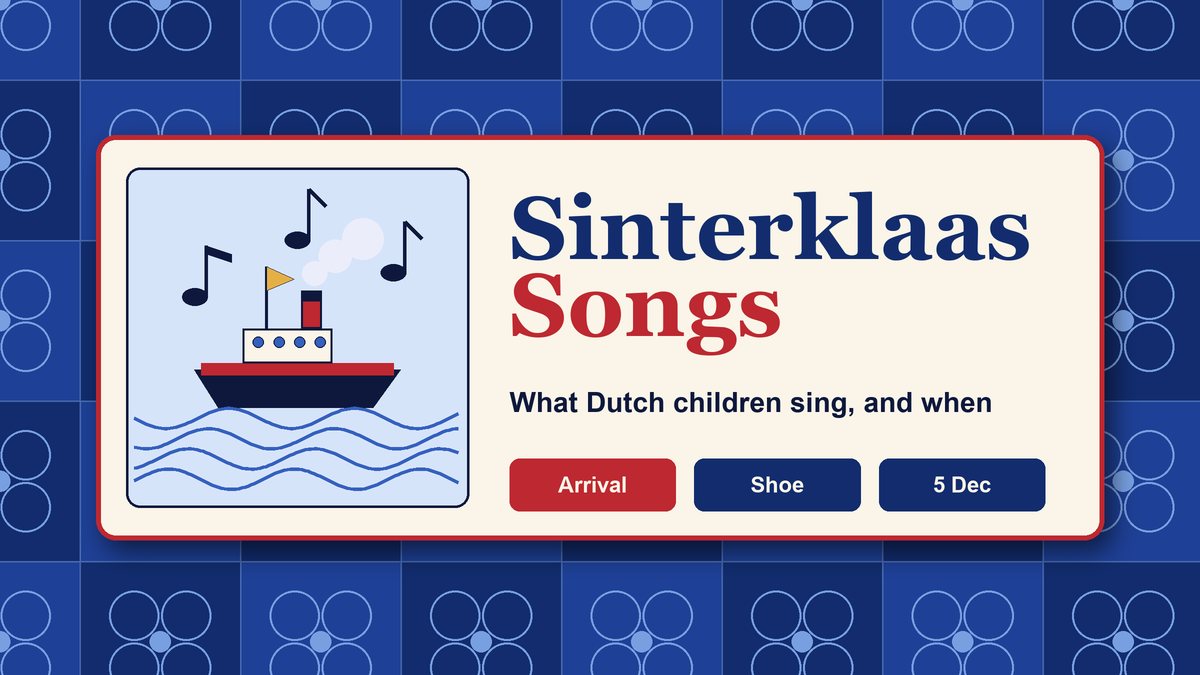
Every November, thousands of Dutch children stand on a quay and sing to a man in a red cloak and bishop's hat who has just stepped off a steamboat. If you have only heard about Sinterklaas as "the Dutch Santa", the songs are the best way into the tradition. They are short, repetitive, passed on by ear, and tied to three specific moments of the season.
The timing is good this year. According to Omroep Brabant, the Dutch broadcaster NTR and the municipality of Land van Cuijk confirmed that the national arrival (landelijke intocht) of Sinterklaas takes place on Saturday 14 November 2026 in the fortress town of Grave on the river Maas. It is the first time since 2000 that the national arrival has been held in the province of Noord-Brabant.
The short answer: Sinterklaas songs (sinterklaasliedjes) are sung at three moments: the arrival (intocht), when children put out a shoe in the evenings, and on pakjesavond, the gift evening on 5 December. The best-known arrival song is Zie ginds komt de stoomboot, which dates from about 1850. Most of the classics are 100 to almost 200 years old.
The three moments when Dutch children sing
Dutch Wikipedia's article on the sinterklaaslied notes that these songs belong to one of the few song cultures that is still passed on mostly by singing rather than by recordings. Three moments are especially tied to them.
1. The arrival (intocht)
Sinterklaas arrives about three weeks before his name day on 6 December. At the national and at the many local arrivals, the children waiting for him sing to Sint and his helpers. Three arrival songs show the range of the repertoire:
- Zie ginds komt de stoomboot uit Spanje weer aan ("Look, the steamboat is arriving from Spain again"): words by Jan Schenkman, about 1850.
- Hij komt, hij komt, die lieve goede Sint ("He is coming, that dear, good Saint"): by Katharina Leopold, 1898, set to the melody of Robert Schumann's Fröhlicher Landmann.
- Daar is een stoomboot aangekomen ("A steamboat has arrived"): printed in a collection from around 1925.
Schenkman's illustrated book Sint Nikolaas en zijn knecht (1850) is also where the Spanish origin, the steamboat and the festive arrival first appear in print, which is why so many arrival songs mention a boat.
2. Putting out the shoe (schoen zetten)
In the weeks that Sint is in the country, children may put a shoe by the fireplace or stove, sometimes with a carrot or hay for his horse, and sing a few songs. Tradition says the music travels up the chimney to the roof. Next morning there may be a sweet or small present in the shoe. The custom of the shoe goes back to at least the 15th century, according to the Wikipedia article, and 17th-century folk songs already mention the hay and the song rising through the chimney.
- Sinterklaas kapoentje, gooi wat in mijn schoentje ("Sinterklaas, little rascal, throw something in my little shoe"): an oral folk song. A Dutch magazine printed a version in 1851 beginning Sint Niklaas, kapoentje! Leg wat in mijn schoentje.
- Sinterklaas is jarig, 'k zet mijn schoen vast klaar ("It's Sinterklaas's birthday, I'm already putting out my shoe"): W. Oostveen, about 1925.
- O, kom er eens kijken, wat ik in mijn schoentje vind: Katharina Leopold, 1898.
3. Gift evening (pakjesavond) and goodbye
In the Netherlands, pakjesavond is usually on 5 December. While children wait for the presents, the family sings. Zie de maan schijnt door de bomen (J.P. Heije, 1843) and Hoor de wind waait door de bomen (about 1925) are among the songs that refer to this evening. Afterwards a farewell such as Dag Sinterklaasje, dag, dag (credited to singer and radio presenter Antoinette van Dijk, 1926) closes the season. In Belgium, gifts are traditionally opened on the morning of 6 December instead.
Hear a few of them
The video below is a half-hour compilation of classic Sinterklaas songs, which gives you the tunes and the call-and-response feel better than any description can.
How the songs changed over the centuries
The repertoire is a layered history of the festival itself, which is what makes it interesting beyond the season.
- 16th and 17th centuries: the oldest surviving songs are mostly saints' songs about Nicholas of Myra. One from 1582 is titled Den sesten December. Sint Nicolaes Bischop and tells how he helped girls and orphans. Songs from the 17th century start to mention gifts and sweets.
- 18th century: the saint is also asked for a marriage partner in comic and love-complaint songs. This theme faded in the 19th century.
- 19th century: the Romantic interest in folk culture leads collectors to write down short children's rhymes that may be far older. At the same time, authors such as J.P. Heije, Jan Schenkman and Katharina Leopold write new songs, and a few dozen of them are still known today.
- Early 20th century: teacher Simon Abramsz publishes twelve songs with piano accompaniment in 1911, and Antoinette van Dijk's radio-era songs appear around 1926. Zwarte Piet appears more and more as Sinterklaas's helper.
- Mid-20th century: Herman Broekhuizen writes songs for the toddler radio programme Kleutertje, luister (1946 to 1975), several of which are about Piet. These are among the last songs added to the traditional repertoire.
Zwarte Piet is part of many of these songs, and the character has been debated in the Netherlands since the 2010s. According to Wikipedia's Sinterklaas article, most cities and television channels now show "soot-smudge Petes" (roetveegpieten) rather than full blackface. The older lyrics are best read as documents of their time.
Radio and TV hits are a different category
Songs written for pop singers and children's TV, such as Sinterklaas, wie kent hem niet (Henk & Henk, 1982), Ik ben toch zeker Sinterklaas niet (Kinderen voor Kinderen, 1986) or Sinterklaasdisco (Gebroeders Ko, 2005), are heard on the radio in the season. Dutch Wikipedia notes that they have mostly not entered the oral tradition and are not what children sing at the shoe or on gift evening.
If you are visiting or just curious
- Watch the national arrival. It is broadcast live on national television in the Netherlands and Belgium; for 2026 that means Saturday 14 November from Grave. Other towns hold their own arrivals later the same Saturday, on the Sunday, or one weekend later.
- Search by first line. Dutch folk songs are known by their opening words, and the Meertens Institute's Dutch Song Database (Nederlandse Liederenbank) is organised that way, with texts and often melodies.
- Expect short, repetitive songs. Many are two or four lines with a refrain, designed so a crowd of children can join in on the first listen.
If you enjoy this side of Dutch music, our guide to famous Dutch folk songs places Zie ginds komt de stoomboot next to the older Dutch songs, Dutch folk music's hidden tradition covers the regional traditions, and Frisian music culture shows how another language community keeps its own songs alive. Some Sinterklaas rhymes were even collected in Frisian in the 19th century.
Sources
- Omroep Brabant: Definitief: landelijke Sinterklaasintocht dit jaar in Grave (national arrival on 14 November 2026, first time in Brabant since 2000)
- Wikipedia (Dutch): Sinterklaaslied (song history, authors, dates, moments of singing; accessed 31 October 2026)
- Wikipedia: Sinterklaas (arrival, Schenkman 1850, Zwarte Piet debate; accessed 31 October 2026)
- Meertens Institute: Nederlandse Liederenbank (Dutch Song Database)
- Minidisco | Kinderliedjes (YouTube): Sinterklaasliedjes compilation